Volvo Cars Malaysia is back with another defensive driving experience for 2026. This time around, Volvo is focusing on its “Selamat” theme. Basically, every time we get behind the wheel, the possibility of something bad happening is just a blink away. However, most of the time, we tend to take road safety for granted, especially as modern-day cars continue to become safer thanks to Advanced Driver Assistance Systems (ADAS).
 Even so, these systems still cannot replace the need to stay aware of your surroundings while driving. The moment you become distracted, anything can happen. For many people, safety is simply something they read about in a vehicle brochure. As long as the vehicle comes fully loaded with safety features, they assume it must be safe. But in reality, how effective these systems are in real-world conditions is something many buyers never truly experience, and there is often no easy way to prove their effectiveness.
For Volvo, safety has always been a core part of the brand’s identity. The company is known for introducing many safety innovations that are now commonly found in modern vehicles, such as the three-point seat belt. Volvo has never stopped innovating when it comes to safety, and this is clearly reflected in the vehicles currently on sale in Malaysia. Every Volvo sold here comes fully equipped with the latest Advanced Driver Assistance Systems expected in a modern vehicle.
To further improve road safety awareness, Volvo Car Malaysia recently held its Selamat Driving Experience. The main goal of the event was to teach participants how to react during defensive manoeuvres, allowing them to better control a vehicle in emergency situations. This is especially important because most drivers have never actually experienced a vehicle losing control. As a result, many panic when it happens in real life. To help more road users gain the knowledge and confidence needed in such situations, Volvo invited members of the media and KOLs to experience the programme firsthand.
The Selamat Driving Experience was held at the newly refurbished Sepang Driving Experience Centre. The facility is connected to new test roads and a skid pan built by Sepang for companies to put their vehicles through various tests. For the driving activities, Volvo prepared a fleet of vehicles for participants to use throughout the exercises. The lineup included the EX30, EC40, XC60, XC90, and of course, the all-new ES90. This also marked the first opportunity for some of us to get behind the wheel of the brand-new ES90.
For the activities, participants were divided into four groups to cover the four different exercises. The first vehicle I drove was the Volvo XC90, Volvo’s evergreen seven-seater SUV. The first activity was the handling course, which took place on twisty roads with varying elevations. The course was designed to test the vehicle’s handling and its ability to cope with different undulations. Being a Continental vehicle, the XC90 delivered impressive handling performance. Even in wet conditions, as it rained throughout the day, the XC90 barely lost traction even when speeds were increased.
Next came the skid control exercise. This activity took place on a wet skid pan equipped with a kick plate to intentionally induce oversteer. For first-timers, it can feel quite intimidating. To demonstrate how older vehicles react without modern stability systems, Volvo brought along a Volvo 240 SE to show how a car behaves without Electronic Stability Programme (ESP). As expected, the vehicle would spin easily. In contrast, modern vehicles equipped with ESP can quickly regain stability, even on wet roads. As drivers, all we needed to do was apply counter-steering, which can truly be a lifesaver on the road. 

Moving on, I switched into the new rear-wheel-drive Volvo EC40. Previously, the EC40 was only available with all-wheel drive, but Volvo introduced the rear-wheel-drive variant in September last year. For the third activity, we participated in the “Brake, Steer, and Avoid” exercise. In this test, we were required to brake as hard as possible while simultaneously steering around an obstacle. To demonstrate the importance of ABS, the driving instructor deactivated the ABS system on a Volvo 940, causing the wheels to lock up under hard braking. Meanwhile, modern vehicles equipped with advanced safety systems managed the situation effortlessly without losing control. 

Lastly, we tackled the emergency lane change exercise. In this activity, we had to react quickly to a sudden change in direction while travelling at speed. The exercise tested our reflexes as we approached obstacles positioned in the middle of the road. In a less stable vehicle, there is a higher chance of the car spinning during such manoeuvres. However, because we were driving Volvos, the vehicles handled the situation with remarkable composure and confidence. 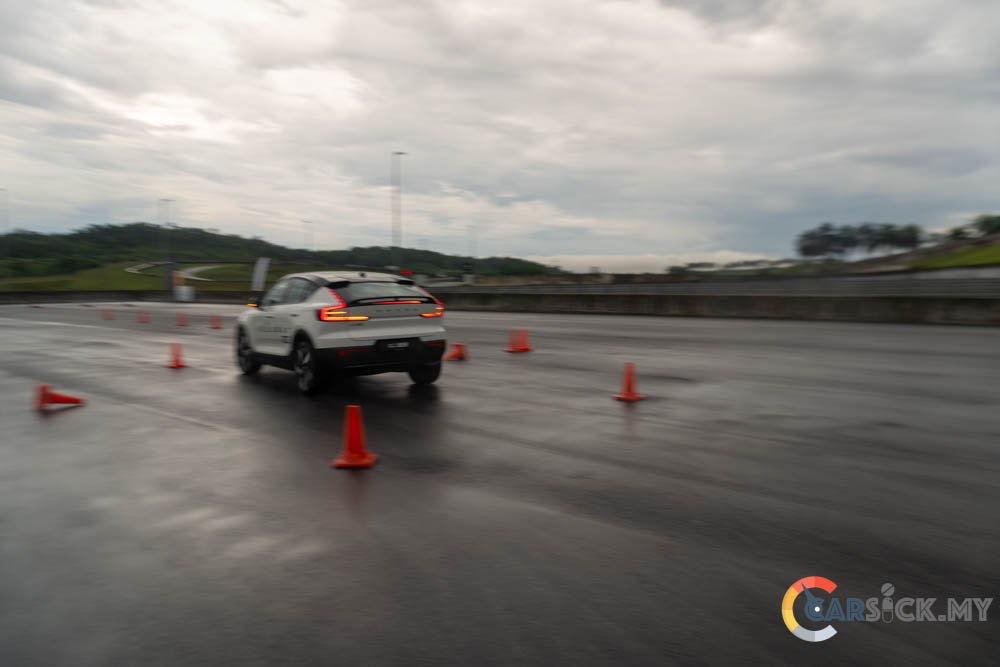

Before concluding the day, Volvo also invited Pirelli to give a short presentation. As the official tyre sponsor, Pirelli educated participants on tyre safety and performance while showcasing its ELECT™ range, which is specifically engineered for EV requirements such as noise reduction, high torque handling, and optimised battery range. Volvo’s electrified models, including the EC40, XC60, and ES90, are fitted with Pirelli’s latest tyres to deliver enhanced braking performance, comfort, and energy efficiency. 

Overall, the Selamat Driving Experience proved to be an excellent initiative by Volvo to promote road safety awareness to a wider audience. The event was even opened to non-Volvo owners, showing the company’s commitment to making Malaysian roads safer for everyone. Through efforts like this, Volvo continues to demonstrate that it is not only focused on building safe cars, but also on encouraging safer driving habits among road users in Malaysia.